Showing posts with label Revision. Show all posts
Showing posts with label Revision. Show all posts
Sunday, October 21, 2012

Thursday, October 18, 2012
Monday, October 8, 2012
Revision - Money
Money is medium of exchange which can clear past and present obligation. Money is anything that is generally accepted as payment for goods and services and repayment of debts.
Functions of money
Money is often defined in terms of the three functions or services that it provides. Money serves as a medium of exchange, as a store of value, and as a unit of account.
Medium of exchange:
Money’s most important function is as a medium of exchange to facilitate transactions. Without money, all transactions would have to be conducted by barter, which involves direct exchange of one good or service for another. The difficulty with a barter system is that in order to obtain a particular good or service from a supplier, one has to possess a good or service of equal value, which the supplier also desires. In other words, in a barter system, exchange can take place only if there is a double coincidence of wantsbetween two transacting parties. The likelihood of a double coincidence of wants, however, is small and makes the exchange of goods and services rather difficult. Money effectively eliminates the double coincidence of wants problem by serving as a medium of exchange that is accepted in all transactions, by all parties, regardless of whether they desire each others’ goods and services.
Store of value:
Money also functions as a unit of account, providing a common measure of the value of goods and services being exchanged. Knowing the value or price of a good, in terms of money, enables both the supplier and the purchaser of the good to make decisions about how much of the good to supply and how much of the good to purchase.
A standard of deferred payment
Money can be used to pay over time for commodities. Goods and services can be paid for in installments over a period of time e.g hire purchase. This was much more difficult and complicated in the barter system.
Characteristics
General acceptance
The essential quality of good money is that it should be acceptable to all, without any hesitation in the exchange for goods and services.
Portability
It is also an important quality of good money that is should be easily transferable from one place to another for doing business and making payment. The paper money is easier to carry because it has minimum possible wait than metallic money.
Storability
Money should be storable and it should not be depreciate with time. If the money used is perishable it will lose its value in few days. Paper money has this quality of storability.
Divisibility
Good money is that which could be divided into small units without losing any value.
Durability
Money should be durable. It should not lose its value with the passage of time. The gold and silver coins do not wear out quickly and quality of money remains the same.
Economy
It is important quality of good money that it should be made economically. If there is heavy cost on issuing more money that is not good money. Good money is that has low cost and more supply. Paper money has this quality of economy.
Revision - Does a Current Account Deficit Matter?
A current account deficit measures the balance of trade in:
The financial account comprises of 2 main features:

Some economists argue we need not worry about a current account deficit. This is because:
Reasons to Worry about a Current Account Deficit.
1. There could be problems financing the deficit in the long term. A short term deficit is not a problem, but if you have a deficit of over 6% of GDP then it is a problem if you rely on Capital flows. A significant part of the current account deficit in US is finance by Chinese investors buying US securities, at relatively low interest rates.
2. Most countries would not be able to borrow such large amounts at low interest rates. The US currently can because the US is seen as the World’s reserve currency. However if attitudes to the US economy change and investors lose their confidence in the US economy, they will stop buying US debt. This will cause 2 problems.
3. In the US the current account deficit is to a large extent caused by excess spending in the economy. It is partly caused by government borrowing which increases Aggregate Demand in the economy and hence growing demand for imports. A large current account deficit is often a sign of an unbalanced economy. It could be a sign of structural weakness and an uncompetitive manufacturing sector. This is particularly a problem in the Eurozone where the exchange rates are permanently fixed.
4. A deficit on the current account increases foreign liabilities. In the beginning a current account deficit could be just a deficit on buying goods. However over time the deficit will be increased by the interest payments on the capital surplus. Foreigners invest in the US. On these investments they receive interest payments or dividends. These dividends count as a debit on the current account. Therefore the longer the deficit goes on the higher the level of investment income debits will be accrued. This means that in the future the economy will need to attract capital flows just to pay off the investment income. As well as the deficit on goods and services.

Example of Iceland's Current Account Deficit

Iceland is an example of a country with a large current deficit which later imploded.
In the years leading up to 2008, there was a sharp inflow of capital to Icelandic banks. This enabled Iceland to run a record current account deficit. Iceland was spending more than they were earning. When capital flows dried up, banks lost money and there was a rapid deterioration in the current account.
 In the Eurozone, current account deficits are a bigger cause for concern because countries have a permanently fixed exchange rate (common currency). Therefore they can't devalue to restore competitiveness. Therefore countries may have to pursue internal devaluation (deflation) to restore competitiveness.
It depends on the size of the current account as a % of GDP. Clearly in Iceland's case, over 20% of GDP was unsustainable. But, in US case 6% of GDP later shrank to a more manageable 3% of GDP.
A current account deficit is often a signal of another underlying problem. For example, a banking boom (in Iceland's case). A boom in domestic demand or a lack of competitiveness in Eurozone.
- goods
- services
- net investment incomes and transfers
The financial account comprises of 2 main features:
- a) Short Term Capital flows e.g. hot money flows and purchase of securities
- b) Long Term Capital flows e.g. investment in building new factories
Some economists argue we need not worry about a current account deficit. This is because:
- If a current account deficit is financed from long term capital inflows then this can be beneficial for the economy. Inward investment can increase the productive capacity of the economy.
- In an era of globalisation it is much easier to attract sufficient capital flows to finance the deficit.
- If the deficit gets too large it will cause a devaluation which helps to reduce the deficit. Also when there is a slowdown in consumer spending the deficit will fall.
- A current account deficit provides an outlet for domestic demand and prevents inflation.
Reasons to Worry about a Current Account Deficit.
1. There could be problems financing the deficit in the long term. A short term deficit is not a problem, but if you have a deficit of over 6% of GDP then it is a problem if you rely on Capital flows. A significant part of the current account deficit in US is finance by Chinese investors buying US securities, at relatively low interest rates.
2. Most countries would not be able to borrow such large amounts at low interest rates. The US currently can because the US is seen as the World’s reserve currency. However if attitudes to the US economy change and investors lose their confidence in the US economy, they will stop buying US debt. This will cause 2 problems.
- US interest rates will need to rise to attract enough people to buy the debt. These higher interest rates will reduce demand in the economy. Higher interest rates will particularly hurt American consumers who have large amounts of debt at the moment.
- If capital flows can’t be attracted then the dollar will continue to devalue further. This could cause inflationary pressures, interest rates may need to rise to stabilise the dollar.
3. In the US the current account deficit is to a large extent caused by excess spending in the economy. It is partly caused by government borrowing which increases Aggregate Demand in the economy and hence growing demand for imports. A large current account deficit is often a sign of an unbalanced economy. It could be a sign of structural weakness and an uncompetitive manufacturing sector. This is particularly a problem in the Eurozone where the exchange rates are permanently fixed.
4. A deficit on the current account increases foreign liabilities. In the beginning a current account deficit could be just a deficit on buying goods. However over time the deficit will be increased by the interest payments on the capital surplus. Foreigners invest in the US. On these investments they receive interest payments or dividends. These dividends count as a debit on the current account. Therefore the longer the deficit goes on the higher the level of investment income debits will be accrued. This means that in the future the economy will need to attract capital flows just to pay off the investment income. As well as the deficit on goods and services.
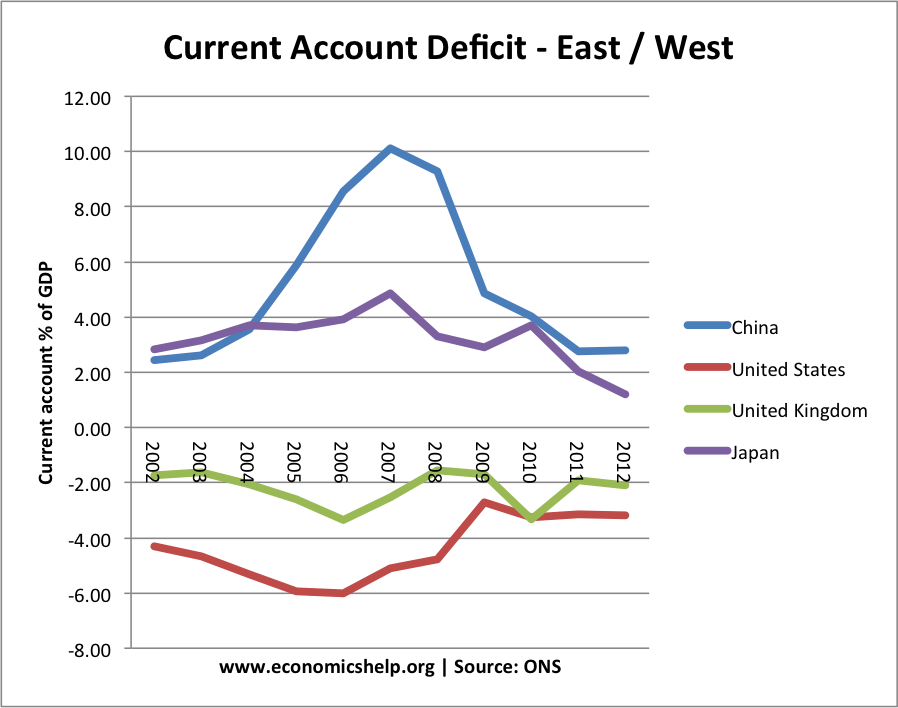
US current account deficit reached 6% of GDP in 2006. This reflected strong domestic demand and a decline in competitiveness. The credit crunch caused a reduction in US current account deficit.
Example of Iceland's Current Account Deficit

Iceland is an example of a country with a large current deficit which later imploded.
In the years leading up to 2008, there was a sharp inflow of capital to Icelandic banks. This enabled Iceland to run a record current account deficit. Iceland was spending more than they were earning. When capital flows dried up, banks lost money and there was a rapid deterioration in the current account.
Current Account Deficits in the Eurozone

Conclusion
It depends on the size of the current account as a % of GDP. Clearly in Iceland's case, over 20% of GDP was unsustainable. But, in US case 6% of GDP later shrank to a more manageable 3% of GDP.
A current account deficit is often a signal of another underlying problem. For example, a banking boom (in Iceland's case). A boom in domestic demand or a lack of competitiveness in Eurozone.
Revision - Factors that determine international competitiveness
A look at factors affecting international competitiveness. International competitiveness is a measure of the relative cost of goods / services from a country. Countries which can produce the same quality of goods at a lower cost are said to be more competitive.
1. Relative Inflation
If the inflation rate is relatively lower than other countries, then over time you become more competitive because your goods will be increasing at a slower rate. For example, in the post war period Japan and Germany had relatively lower inflation rates than major competitors, this helped them to become more competitive.

2. Productivity
Productivity is a measure of output per input. The most common measure would be labour productivity. For example, with improved technology and education, a country can enjoy higher labour productivity and therefore produce goods at a lower cost. Higher labour productivity is the key to increasing competitiveness and living standards at the same time.
 German vs Italian labour productivity. During this period, Italian labour productivity growth has tended to lag behind Germany, leading to lower competitiveness of Italian exports.

3. Exchange Rate
Movements in the exchange rate will determine competitiveness. For example, a sharp depreciation will make exports cheaper and more competitive. An increase (appreciation) in the exchange rate, makes the foreign currency price more expensive.
Often movements in the exchange rate reflect relative costs. For example, if a country has lower inflation, this will lead to an appreciation in the exchange rate, making exports relatively more expensive. Thus a floating exchange rate, helps to maintain relative competitiveness levels.
However, sometimes economies can artificially maintain a lower value of the exchange rate to maintain competitiveness. For example, China has been accused of exchange rate manipulation. China buys large quantities of US securities, this causes an increase in the value of the dollar and helps to keep the Yuan undervalued. Therefore, this helps Chinese exports to be more competitive and explains the large Chinese current account surplus
Government has used supply side policies to increase productivity. E.g. education and training.
However, there is a limit to what the government can do to increase productivity. Increased productivity can be due to other factors.

Competitiveness in the Euro
In the Euro, countries have a permanently fixed exchange rate - they cannot devalue to restore competitiveness. Therefore divergences in labour costs and productivity will have a bigger impact on competitiveness than in a floating exchange rate. See: EU Competitiveness
4. Tax Rates
Tax rates on labour and corporations will be a factor in determining competitiveness. For example, higher labour taxes will increase the unit cost of labour faced by firms, leading to lower competitiveness.
5. Cost of Doing Business
It is argued that countries with more labour market regulations and regulations about doing business will have higher costs and lower competitiveness. For example, the difficulty in gaining planning regulations to expand a factory.
The World Bank produce a list of countries which are the 'easiest places to do business'. The criteria include factors such as flexibility of labour markets, degree of regulations, protection of private property.
Top 10 Ease of doing business
6. Infrastructure
A key factor in determining competitiveness is the cost of transport. For example, some argue the UK's competitiveness is undermined by bottlenecks in transport, such as limited airport capacity in London and traffic jams on major roads.
1. Relative Inflation
If the inflation rate is relatively lower than other countries, then over time you become more competitive because your goods will be increasing at a slower rate. For example, in the post war period Japan and Germany had relatively lower inflation rates than major competitors, this helped them to become more competitive.

This graph of relative inflation rates showed that during the period shown, inflation in Greece fell from close to 5% to below 2%. This suggests that Greece will have become slightly more competitive in this period.
2. Productivity
Productivity is a measure of output per input. The most common measure would be labour productivity. For example, with improved technology and education, a country can enjoy higher labour productivity and therefore produce goods at a lower cost. Higher labour productivity is the key to increasing competitiveness and living standards at the same time.


This shows labour productivity index for UK and Germany. Between 1990 and 2005, Germany labour productivity increased 25 base points. UK labour productivity increased by 35 base points. Showing that the UK had faster improvements in labour productivity during this period.
3. Exchange Rate
Movements in the exchange rate will determine competitiveness. For example, a sharp depreciation will make exports cheaper and more competitive. An increase (appreciation) in the exchange rate, makes the foreign currency price more expensive.
Often movements in the exchange rate reflect relative costs. For example, if a country has lower inflation, this will lead to an appreciation in the exchange rate, making exports relatively more expensive. Thus a floating exchange rate, helps to maintain relative competitiveness levels.
However, sometimes economies can artificially maintain a lower value of the exchange rate to maintain competitiveness. For example, China has been accused of exchange rate manipulation. China buys large quantities of US securities, this causes an increase in the value of the dollar and helps to keep the Yuan undervalued. Therefore, this helps Chinese exports to be more competitive and explains the large Chinese current account surplus
Government has used supply side policies to increase productivity. E.g. education and training.
However, there is a limit to what the government can do to increase productivity. Increased productivity can be due to other factors.
Competitiveness in the Euro
In the Euro, countries have a permanently fixed exchange rate - they cannot devalue to restore competitiveness. Therefore divergences in labour costs and productivity will have a bigger impact on competitiveness than in a floating exchange rate. See: EU Competitiveness
4. Tax Rates
Tax rates on labour and corporations will be a factor in determining competitiveness. For example, higher labour taxes will increase the unit cost of labour faced by firms, leading to lower competitiveness.
5. Cost of Doing Business
It is argued that countries with more labour market regulations and regulations about doing business will have higher costs and lower competitiveness. For example, the difficulty in gaining planning regulations to expand a factory.
The World Bank produce a list of countries which are the 'easiest places to do business'. The criteria include factors such as flexibility of labour markets, degree of regulations, protection of private property.
Top 10 Ease of doing business
- Singapore
- Hong Kong
- New Zealand
- United States
- Denmark
- Norway
- United Kingdom
- South Korea
- Iceland
- Ireland
6. Infrastructure
A key factor in determining competitiveness is the cost of transport. For example, some argue the UK's competitiveness is undermined by bottlenecks in transport, such as limited airport capacity in London and traffic jams on major roads.
Monday, September 24, 2012
Revision - Should the government intervene in the economy?
One of the main issues in economics is the extent to which the government should intervene in the economy. Free market economists argue that government intervention should be strictly limited as government intervention tends to cause an inefficient allocation of resources. However, others argue there is a strong case for government intervention in different fields.

Hoover Dam built in the 1930s with government funds
Summary of whether should the government intervene in the economy.
Arguments for Government Intervention
- Greater Equality – redistribute income and wealth to improve equality of opportunity and equality of outcome
- Market Failure – Markets fail to take into account externalities and are likely to under-produce public / merit goods.
- Macroeconomic intervention. – intervention to overcome prolonged recessions and reduce unemployment.
Arguments against Government Intervention
- Governments liable to make the wrong decisions – influence by political pressure groups, they spend on inefficient projects which lead to inefficient outcome.
- Personal Freedom. Government intervention is taking away individuals decision on how to spend and act. Economic intervention, takes some personal freedom away.
- Market is best at deciding how and when to produce.
Arguments for Government Intervention to improve equality
In a free market, there tends to be inequality in income, wealth and opportunity. Private charity tends to be partial. Government intervention is necessary to redistribute income within society.
Diminishing marginal returns to income. The law of diminishing returns states that as income increases, there is a diminishing marginal utility. If you have an income of £2 million a year. An increase in income to £2.5 million gives only a marginal increase in happiness / utility. For example, your third sports car gives only small increase in total utility.
However, if you are unemployed, and surviving on £50 a week. A 10% increase in income gives a substantial boost in living standards and quality of life. Therefore, redistributing income can lead to a net welfare gain for society, therefore income redistribution can be justified from a utilitarian perspective.
Fairness. In a free market, inequality can be created, not through ability and handwork, but privilege and monopoly power. Without government intervention, firms can exploit monopoly power to pay low wages to workers and charge high prices to consumers. Without government intervention, we are liable to see the growth of monopoly power. Government intervention can regulate monopolies and promote competition. Therefore government intervention can promote greater equality of income, which is perceived as fairer.
Inherited wealth. Often the argument is made that people should be able to keep the rewards of their hard work. But, if wealth and income and opportunity depend on being born in the right family, is that justified? A wealth tax can reduce the wealth of the richest and this revenue can be used to spend on education for those who are born in poor circumstances.
Rawls Social Contract. Rawls social contract stated that the ideal society is one where you would be happy to be born in any situation, not knowing where you would end up. Using this social contract, most people would not choose to be born in a free market because the rewards are concentrated in the hands of a small minority of the population. If people had no idea where they would be born, they would be more likely to choose a society with a degree of government intervention and redistribution.
Types of Government Intervention
Public Goods. In a free market, public goods such as law and order and national defence would not be provided because there is no fiscal incentive to provide goods with a free rider problem (you can enjoy without paying them). Therefore, to provide public goods like lighthouses, police, roads, e.t.c it is necessary for a government to pay for them and out of general taxation.
Merit Goods. Goods like education and health care are not strictly public goods (though they are often referred to as public goods). In a free market, provision tends to be patchy and unequal. Universal education provided by the government ensures that, in theory, everyone has the opportunity to gain an education, which has a strong social benefit.
Negative Externalities. The free market does not provide the most socially efficient outcome, if there are externalities in consumption and production. For example, a profit maximising firm will ignore the external costs of pollution through burning coal. This leads to a decline in social welfare. By contrast other forms of energy production, like solar power, are environmentally friendly and have a positive externality. By taxing production which causes pollution costs and using the subsidy to encourage other forms of energy production, there is a net gain in social welfare.
Macro Economic Intervention.
In recessions, there is a sharp fall in private sector spending and investment, leading to lower economic growth. If the government also reduce spending at the same time, there is an even bigger fall in economic growth and collapse in confidence. In a deep recession, governments can borrow from the private sector and spend the money to employ unemployed resources. If there is a collapse in the money supply, there maybe a role for Central bank or Government to print money. Similarly, the government may need to prevent an economic boom and explosion of credit. Keynesian economists argue that the government can positively influence the economy through fiscal policy. Monetarists believe monetary policy can help encourage economic stability, though an independent Central Bank may not be considered government intervention.
Arguments against Government Intervention
- When governments spend on public goods and merit goods, they may create excess bureaucracy and inefficiency.
- State owned industries tend to lack any profit incentive and so tend to be run inefficiently. Privatising state owned industries can lead to substantial efficiency savings.
- Politicians don’t have the same market discipline of seeking to maximise the use of limited resources.
- Government intervention causes more problems than it solves. For example, state support of industries may encourage the survival of inefficient firms. If governments bailout banks, it may create moral hazard where in the future banks have less incentive to avoid bankruptcy because they expect a government bailout.
- Real business cycle theorists argue that at best government intervention makes no difference to the length of a recession, but may just create additional problems, such as the accumulation of public sector debt.
Conclusion
There is no real model of a society run in the absence of government intervention. Even the most extreme libertarian economists would accept there needs to be some state protection of property rights and spending on national defence. The debate comes on the extent of government intervention. This needs to take place on each aspect of government intervention. The arguments for and against government intervention in macro economic stabilisation are very different to the arguments for and against providing universal health care. It is not satisfactory.
Subscribe to:
Posts (Atom)